Texas judge orders First Brands creditors to prove ownership as duplicate invoices surface
First Brands' collapse exposed multiple lenders with claims on the same receivables after the auto parts supplier sold identical invoices to different financiers over years.
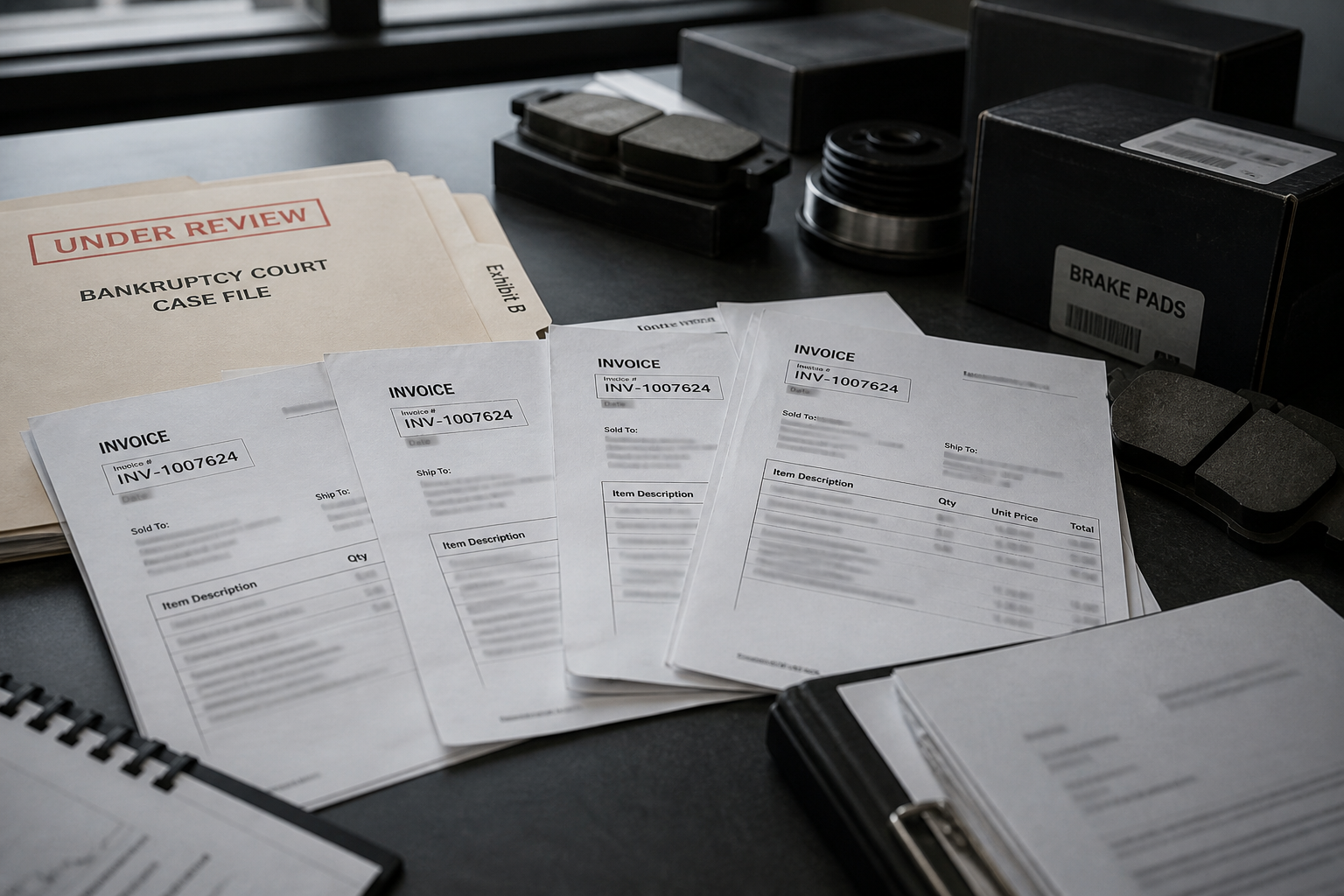
The Texas bankruptcy judge did not mince words. Judge Christopher Lopez ruled on August 24 that First Brands' proposed plan to sue insiders was "not feasible," converting the case to Chapter 7 liquidation, according to Reuters on August 24.
What is at stake is not how much First Brands lost, but who was holding it. The company listed liabilities at more than $10 billion when it filed for Chapter 11 in September 2025, according to its bankruptcy petition, as reported in the First Brands filing from September 2025. The same parts supplier, the same unpaid invoices, the same missing inventory, but three or four different lenders who each thought they owned the claim.
Patrick James and his brother Edward James built the arrangement over two decades, taking First Brands from a modest auto parts maker in Ohio into a sprawling supplier of brake pads, spark plugs, wiper blades and filters. They produced under names including FRAM, Autolite and Trico. By 2025, First Brands had grown into the middleman between Detroit automakers and local repair shops across the country.
The structure that collapsed was never disguised. GTR reported on September 30, 2025, that First Brands had accrued $2.3 billion in factoring liabilities, selling the same receivables to multiple finance providers. When a shipment generated one invoice, it created one claim. But when the same invoice was sold to three different factors, and each borrowed against that paper, the claims multiplied and the documentation diverged.
Allianz, Coface, and AIG wrote trade credit policies that shielded suppliers and investors from exactly this kind of loss, according to the Financial Times on October 10, 2025. Morningstar DBRS, as cited in The Insurer on October 14, 2025, reported that the trade credit insurers faced a test case with possible exposure reaching the entire value of First Brands' supply chain financing programs. Some of these insurers had begun cutting limits well before the bankruptcy, after catching wind of payment problems at just one operating unit.
The lenders who bought these receivables expected the insurers to pay. The insurers expected the collateral to exist. The collateral was the same invoice sold three times. Insurers measure this in months of claims adjudication. For the small parts supplier who shipped goods but has not been paid in a year, it is measured by whether the company can keep its doors open.
The standard metrics—receivable aging schedules, trade credit limits, factoring advance rates—missed what counted. The same receivable had been sold to three different buyers, with each reassured that theirs was the only one.
First Brands' managers proposed a litigation trust in June 2026 that would sue former insiders and third-party financiers, targeting recoveries in the billions, according to GTR on August 26. Marc Kirschner, a bankruptcy expert, supported that estimate in Truck Parts & Service on July 17, 2026. Judge Lopez ruled that the plan violated bankruptcy rules and was not feasible.
With the case converted to Chapter 7, a court-appointed trustee now takes control of what remains. The estate, however, has been largely consumed; at least $222 million in administrative claims accumulated during the bankruptcy itself, The BRAKE Report wrote on August 26. Unsecured creditors, including suppliers who delivered parts but were never paid, stand at the back of a line reaching assets that have already been drained.
The historical precedent is not 2008, though comparisons have been drawn. The stronger model is Enron: a company that appeared normal but was, as FBI Special Agent Kareem Carter put it in the DOJ SDNY indictment on January 29, 2026, "used as a Ponzi scheme." The James brothers were accused of using new loans to pay past debts and fund personal extravagance; a co-conspirator pleaded guilty in January.
The counterpoint is that Enron triggered a wholesale restructuring of audit and disclosure rules. First Brands operated in private credit, a market with no public filings, no analyst coverage, and no obligation to inform investors that the same invoice was sold to multiple parties. The gap that enabled the fraud remains the norm for the sector.
Who pays
Jefferies disclosed a $30 million loss on lending exposure to First Brands, according to the Financial Times in late 2025. GTR reported on September 29, 2025, that supply chain finance providers were exposed to more than $866 million when the bankruptcy struck. The lenders who filled these factoring programs included PrimeRevenue, Katsumi Global, Onset Financial, and Leucadia Asset Management, according to GTR on August 26.
The trade credit insurers now face a cascade of claims from policyholders who thought they were protected. But when the collateral is phantom, the insurance payouts cover a loss both sides thought had real assets behind it. Morningstar DBRS called this a test for trade credit insurance boundaries under systematic fraud, as reported in The Insurer on October 14, 2025.
The ultimate question of who pays, and who already has, lands squarely on the private credit market. First Brands was not a speculative lender blow-up. It was a manufacturer using standard financing tools—factoring, supply chain finance, trade credit—and turning them into a method for selling the same risk to every buyer. Every fund with trade credit exposure, every insurer, every finance provider that advanced against a First Brands invoice now holds part of a loss they did not know they were underwriting.
A trade credit fund rebalancing month to month may already have absorbed the loss. A pension with a long-dated private credit allocation likely has not yet started to price it.
The problem runs deeper. Dozens of other private companies use the same opaque structures and tools. The judge's ruling this week did not create the losses; it simply made clear who was left holding them.